Sustainability
Sustainability, Considered from Every Angle
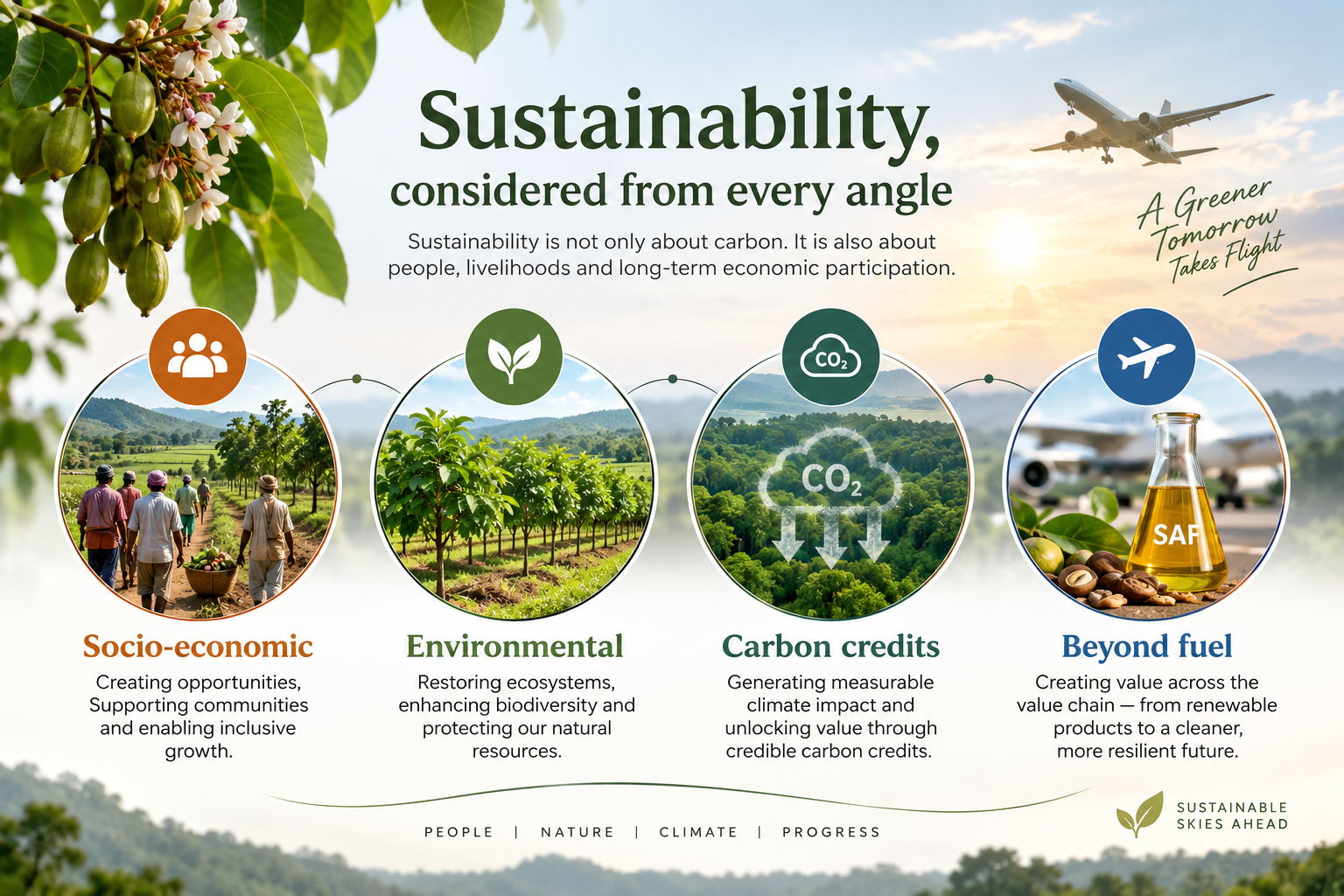
Sustainability is not only about carbon. It is also about people, livelihoods and long-term economic participation. Here is how we think about the socio-economic, environmental and long-term value of what we build.
Our approach
A broader definition of sustainability
It would be easy to reduce sustainability to a single number, tonnes of carbon avoided. We think that misses most of the story. A feedstock supply chain touches farmers, landowners, collectors, workers and their families long before it touches a fuel producer, and we try to account for that at every stage of our thinking.
That means asking not only "does this reduce emissions?" but also "does this create fair, lasting value for the people involved?" and "can we prove it, with documentation that stands up to scrutiny?"
The four tabs below walk through how we think about socio-economic impact, environmental outcomes, carbon-related opportunities, and the applications that could take Pongamia beyond fuel altogether.
Our model is designed to create opportunities across the value chain, from Pongamia cultivation and seed aggregation to oil processing, UCO collection, logistics and associated services.
- Local employment across collection, aggregation, processing, plantation and logistics activities
- Additional income opportunities for farmers and landowners through suitable Pongamia cultivation models
- Participation of local entrepreneurs and collection partners in the UCO ecosystem
- Long-term relationships with communities rather than short-term extraction of value
- Development of rural and semi-urban supply-chain infrastructure
Our objective is to build a business where the growth of the renewable feedstock ecosystem also creates tangible local economic value, jobs that last, and income that compounds over multiple harvest cycles rather than a single transaction.
The transition from fossil-derived jet fuel to Sustainable Aviation Fuel can reduce lifecycle greenhouse-gas emissions when SAF is produced from qualifying sustainable feedstocks and processes. The actual reduction depends on feedstock, land-use impacts, production pathway, energy inputs, transport, processing and the methodology used to calculate lifecycle emissions.
Pongamia and UCO can offer different sustainability advantages: Pongamia provides an opportunity to develop a renewable non-food oilseed resource, while UCO enables the recovery of an existing waste stream. Responsible sourcing and robust traceability are essential to ensuring that environmental benefits are real and measurable, not just assumed.
Our goal is to support renewable fuel supply chains that are scientifically assessed, responsibly sourced and aligned with applicable sustainability standards.
Pongamia programmes may have potential for carbon-related environmental attributes where the underlying project, methodology, additionality, monitoring and verification requirements are met. Potential value can arise from factors such as biomass accumulation and soil-related carbon outcomes, depending on the project design and applicable methodology.
Carbon credits should not be assumed simply because a plantation is established. Any crediting opportunity must be assessed under an appropriate methodology and independently verified where required, we treat this as a rigorous, evidence-led process rather than a marketing claim.
We intend to explore credible carbon and environmental-attribute opportunities alongside the physical feedstock business, as a complement to it, not a substitute.
Our vision for Pongamia extends beyond oil for fuel. We are exploring opportunities to develop higher-value applications across the Pongamia value chain.
Pongamia-based bioplastic potential. Pongamia oil contains fatty acids and other components that may be suitable starting points for research into bio-based polymers, coatings, resins and other materials. Commercial viability depends on formulation, processing, performance, economics and regulatory requirements.
Value from Pongamia meal. The protein-rich fraction remaining after oil extraction may offer opportunities for value-added applications. With appropriate detoxification, safety testing, nutritional validation and regulatory approval, future research could explore feed or other protein-related applications. This is an area for development rather than a current claim of suitability.
Our goal is simple: maximise the value of every seed, every litre and every partnership.
Our framework
Four pillars we measure ourselves against
People
Fair, lasting livelihoods for farmers, collectors, workers and local communities across the supply chain.
Planet
Lower-carbon feedstock pathways, responsibly sourced, with real and measurable environmental outcomes.
Prosperity
Long-term rural income through Pongamia plantation economics that compound over decades, not seasons.
Partnership
Built with communities and partners, with transparent documentation instead of one-sided claims.
Common questions
Sustainability, explained
Not as a standalone product today. We are exploring credible carbon and environmental-attribute opportunities alongside the core feedstock business, subject to appropriate methodology and independent verification.
Actual lifecycle emissions reduction depends on feedstock, land use, production pathway and methodology. We support scientifically assessed, responsibly sourced supply chains rather than making unverified claims.
Farmers and landowners can access additional income opportunities through Pongamia cultivation, along with participation in a growing local collection and processing ecosystem.
Building a sustainability programme or certification pathway?
We're open to conversations with certification bodies, sustainability partners and researchers exploring Pongamia and UCO feedstocks.