Used Cooking Oil
Turning a Food-Safety Risk into a Traceable Feedstock
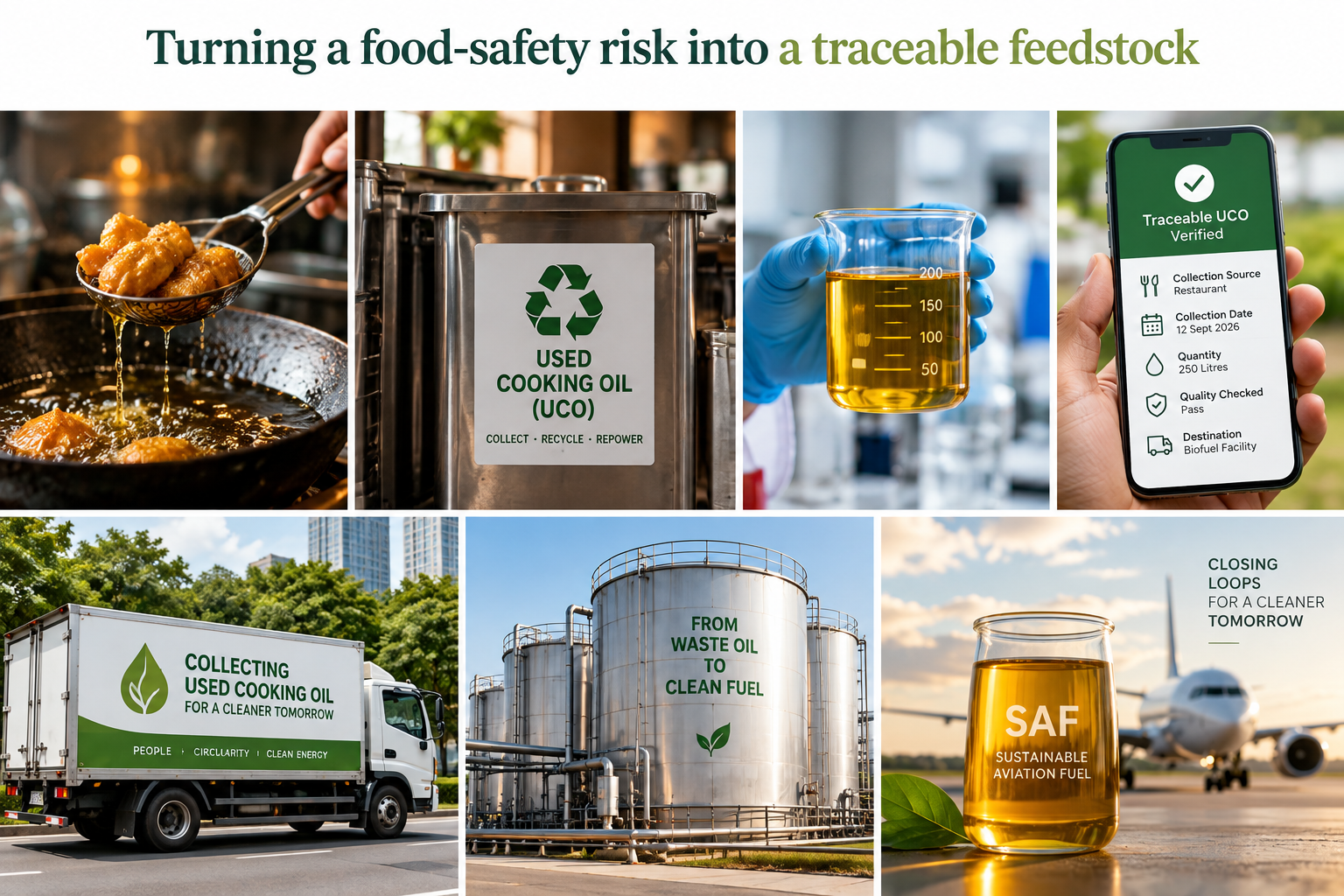
Used Cooking Oil is generated every day by restaurants, hotels, caterers and commercial kitchens across India. Left unmanaged, it is a food-safety and waste-management problem. Collected responsibly, it becomes a valuable renewable feedstock.
A fragmented problem, formalised
Why Used Cooking Oil matters
When Used Cooking Oil is discarded improperly, it creates waste-management problems for municipalities and drains. When it is illegally diverted back into the food chain, it creates a serious food-safety concern for consumers. Neither outcome is acceptable, and both are avoidable.
Recovering UCO through a controlled, well-documented collection network creates a better alternative: a difficult waste stream is redirected into legitimate industrial uses and renewable fuel pathways, rather than back onto someone's plate.
The opportunity is to formalise a fragmented, largely informal collection ecosystem and bring greater visibility to where UCO comes from, how it is collected, how it is stored, and where it ultimately goes. We aim to connect food-service establishments with responsible collection channels while building the documentation and traceability that downstream customers and applicable sustainability schemes require.
.png)
The collection model
The HORECA collection model
Our collection network can work with Hotels, Restaurants and Cafés (HORECA), along with caterers, institutional kitchens, food manufacturers and other suitable commercial generators.
Each relationship starts with a straightforward onboarding conversation about volume, schedule and storage, and grows into a dependable, scheduled pickup arrangement built for both sides.
Step by step
Our collection & traceability process
- 01
Onboarding
Identify eligible UCO generators and establish a collection relationship.
- 02
Collection
Schedule regular pickup based on generation volume and location.
- 03
Segregation
Keep UCO separate from general waste and unsuitable materials.
- 04
Storage
Use appropriate containers and handling practices to minimise contamination.
- 05
Documentation
Maintain records of collection quantities, source details and movement.
- 06
Aggregation
Consolidate UCO through controlled collection points and logistics.
- 07
Quality
Inspect incoming material and manage quality parameters required by buyers.
- 08
Traceability
Build a documented chain from source to final delivery, subject to applicable certification and customer requirements.
Our long-term network can extend to food processors, institutional kitchens, caterers, canteens and other commercial generators where collection can be conducted responsibly and economically.
For renewable fuel markets, feedstock origin and sustainability evidence can be as important as physical quality. Our objective is to build traceability from the first transaction rather than attempting to reconstruct the supply chain later.
Who we collect from
We collect from every kitchen towards a sustainable future
If your business generates used cooking oil, there is very likely a collection model that fits your kitchen.
Hotels & Resorts
Multi-outlet properties with high, predictable UCO volumes and banquet kitchens.
Restaurants & Cafés
Independent and chain restaurants of every size, from quick-service to fine dining.
Caterers & Event Kitchens
Banquet halls, event caterers and large-scale function kitchens with variable schedules.
Institutional Kitchens
Hospitals, schools, corporate cafeterias and canteens with recurring, high-volume needs.
Cloud & Quick-Service Kitchens
Delivery-first kitchens generating frequent, smaller volumes suited to scheduled pickup.
Food Manufacturers
Processors and manufacturers with dedicated frying lines and consistent by-product volumes.
Why it matters
Four reasons UCO collection deserves to be formal
Food Safety
Formal collection closes the door on UCO being illegally diverted back into the food chain.
Waste Reduction
Diverting UCO away from drains and general waste reduces environmental and municipal burden.
Circular Economy
A waste stream is given a second life as an industrial and renewable fuel input.
Renewable Feedstock
Recovered UCO becomes a real input into Sustainable Aviation Fuel and renewable diesel pathways.
Common questions
UCO collection, explained
Hotels, restaurants, cafés, caterers, institutional kitchens, cloud kitchens and food manufacturers, essentially any commercial kitchen generating used cooking oil on a regular basis.
We recommend appropriate, sealed containers to minimise contamination and simplify handling. Our team can advise on suitable storage as part of onboarding.
Pickup frequency is scheduled based on your generation volume and location, ranging from weekly to less frequent routes for smaller kitchens.
Collection records covering quantities, source details and movement are maintained as part of our traceability process, supporting your own documentation needs.
Run a commercial kitchen?
Let's set up a responsible, scheduled UCO collection arrangement for your business.