Pongamia · Cultivation
Pongamia Cultivation — The Agronomy Behind Our Feedstock
Australian buyers building an ESG case around imported feedstock often want to understand the agronomy, not just the finished oil. Here is how our Maharashtra farmer partners cultivate Pongamia.
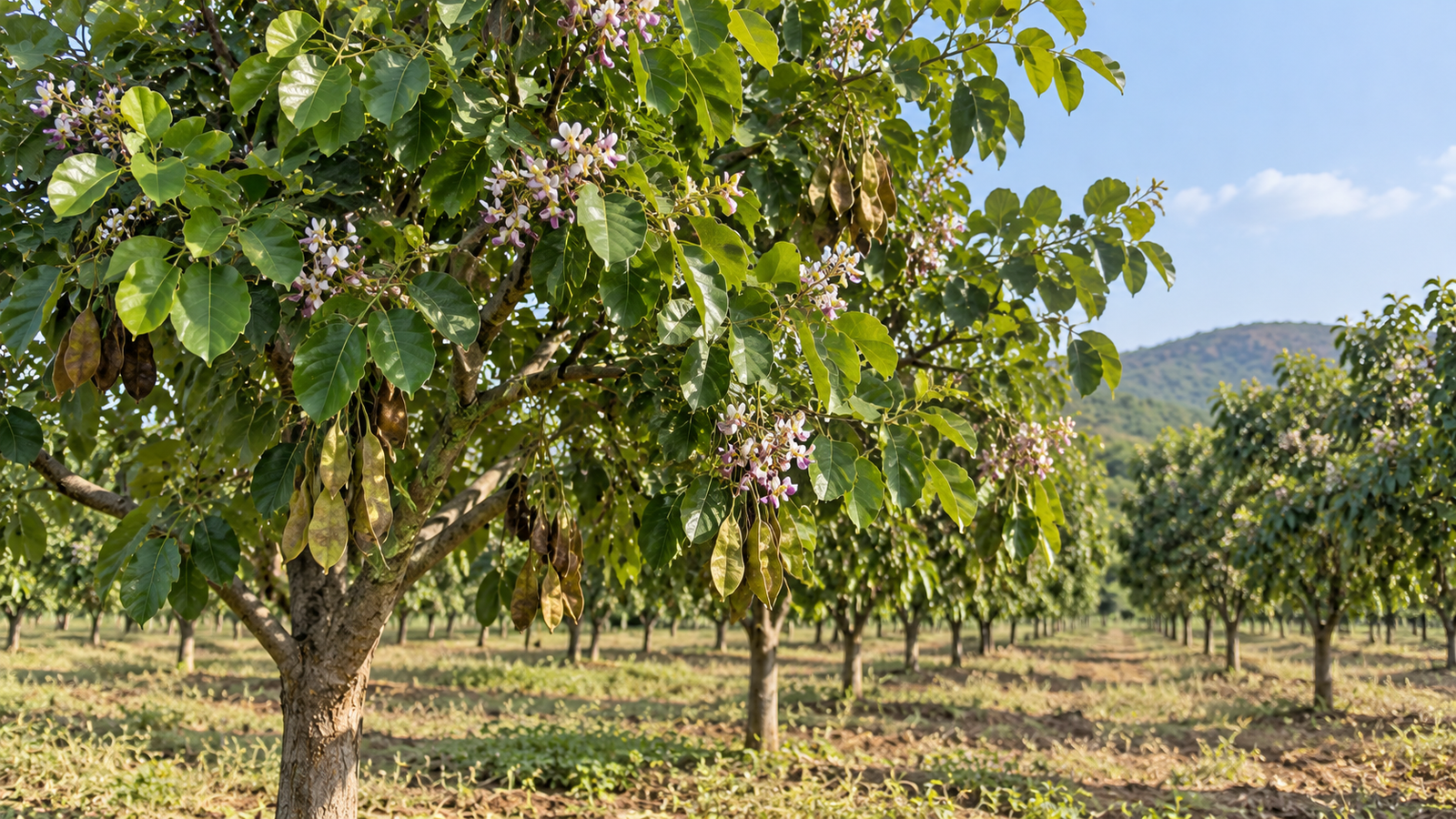
Pongamia Cultivation Australia buyers evaluate involves a hardy, nitrogen-fixing, drought-tolerant tree grown on marginal Indian farmland unsuited to food crops; Ranjit Oil Mills India's farmer partners cultivate it with low ongoing input across a multi-decade productive lifespan.
Why Pongamia suits marginal farmland
The agronomic case for Pongamia as a feedstock tree
Pongamia is often described commercially as a non-edible oilseed tree, but the agronomic detail behind that description is what actually supports its sustainability case. It is drought-tolerant, tolerant of poor and saline soils, and, as a legume, capable of fixing nitrogen into the soil it grows in, which means it can be cultivated on land too marginal for most food crops while gradually improving that land's fertility.
Our farmer partners across Maharashtra cultivate Pongamia with comparatively low ongoing input once trees are established, relying on the tree's natural drought tolerance rather than intensive irrigation. Trees typically take several years to reach full seed-bearing maturity, but then remain productive for decades, giving farming partners a long-term, low-maintenance income stream alongside their other agricultural activity.
For Australian buyers, understanding this agronomic backdrop, rather than just the oil specification, is often relevant to building a credible sustainability narrative around imported Pongamia feedstock, particularly where buyers need to speak to land-use and soil-impact questions as part of their own reporting.
Why choose us
What our cultivation approach supports
Agronomic practice shapes the sustainability story that ultimately reaches Australian buyers.
Marginal-Land Focus
Cultivation is concentrated on land not competing with food-crop production.
Low-Input Farming
Established trees require comparatively little irrigation or fertiliser input.
Soil-Improving Growth
As a nitrogen-fixing legume, Pongamia can improve soil conditions over its growing life.
Long Productive Lifespan
Trees remain productive for decades, supporting stable long-term farmer income.
How Pongamia is cultivated by our farmer partners
From planting to a mature, productive tree
A multi-year cultivation cycle underpins every seed harvest.
Site Selection
Marginal land unsuited to food crops is identified for new Pongamia planting.
Sapling Establishment
Young trees are planted and given initial support during early growth.
Low-Input Growing Phase
Trees are grown with minimal irrigation and fertiliser as they mature.
Maturity & First Yield
Trees begin bearing harvestable seed pods after several growing seasons.
Seasonal Harvest
Seed pods are harvested during the designated harvest window each year.
Ongoing Productive Cycle
Mature trees continue yielding seed annually for decades.
What buyers ask about origin
Answering the sustainability questions Australian buyers raise
Buyers increasingly ask suppliers questions that go beyond product specification, wanting to understand whether a feedstock's origin displaces food production, degrades soil, or depends on heavy irrigation in a way that raises its own environmental footprint. Pongamia's cultivation profile, marginal-land use, low input requirements and soil-improving growth, is generally a favourable answer to that line of questioning.
We can share information about our farmer partners' growing regions and general cultivation practices to support Australian buyers preparing their own sustainability documentation, recognising that the agronomic story behind a feedstock is now as commercially relevant as its chemical specification.
- Cultivation concentrated on marginal, non-food-competing land
- Low irrigation and fertiliser requirements once trees are established
- Nitrogen-fixing growth habit supports gradual soil improvement
- Information available to support buyer sustainability documentation
Common questions
Pongamia cultivation — common questions
No, it is grown on marginal land generally unsuited to food-crop cultivation, avoiding direct competition with food production.
Established Pongamia trees are drought-tolerant and require comparatively little irrigation compared with many conventional crops.
Trees typically take several years to reach full seed-bearing maturity, then remain productive for decades.
Yes, we can share general information about our farmer partners' growing regions and practices to support buyer documentation.
Explore more
Related Australia & feedstock pages
Need cultivation detail for a sustainability submission?
Ask us for growing-region information and general agronomic detail to support your own documentation.